

Romantic Historical Fiction Books by Thomas Hamby
Immerse yourself in the captivating worlds of romantic historical fiction with Thomas Hamby Books. Witness the regal charm of the British Regency period come alive, intertwining love, history, and the elegance of the 19th century with enthralling and inspiring narratives.

About Me
I’m Thomas Hamby, known in the literary world as D B Thomas. Born in Tennessee, I am a romance author who crafts tales against the lush backdrop of 19th-century Britain, inspired by literary icons such as Jane Austen and Elizabeth Gaskell. As a retired diplomat with a career that spanned the globe, I discovered my dual love for acting and writing during a journey of self-renewal, kindling the flame of regency-era fiction for a new generation.
I split my time between the sunny shores of Florida and the serene landscapes of Finland with my Finnish spouse, leading a life as rich and varied as the characters I create. I hold Bachelor of Arts and Master of Science degrees, which have paved the way for a colorful career from Tennessee to London and beyond. This has filled my world with cultural exploration and artistic endeavors.
During a sojourn in the UK, my diplomatic duties gave me the honor of meeting Her Majesty Queen Elizabeth. Our discussion on agriculture’s pivotal role in civilization’s past and future left a lasting impression on me, further deepening my appreciation for British heritage and its literary and theatrical marvels.
Rediscovering Jane Austen
The spark that reignited my passion for writing was the release—and subsequent cancellation—of Sanditon season 1 in 2019. Moved by the series’ untimely conclusion, I turned to social media to share my envisioned continuations, captivating a global audience with my weekly chapters in 2020. My serialized works, Sanditon – HEA Found, have amassed over 45,000 reads on Booksie.com and have cultivated a dedicated following across the English-speaking world and Italy.
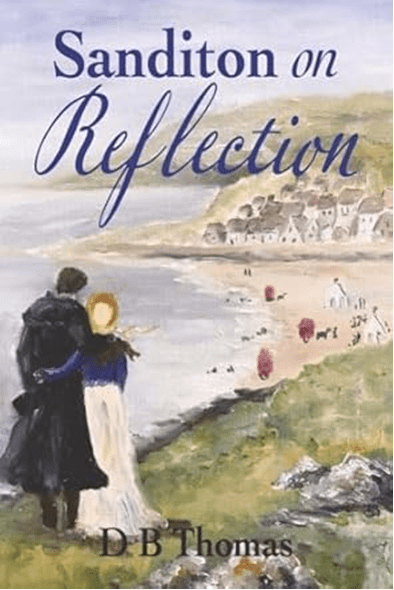
From this labor of love emerged Sanditon on Reflection and its Italian counterpart, Ricordi di Sanditon. These efforts solidified my role as a torchbearer for Austen’s legacy, offering new tales for fans of classic British literature.

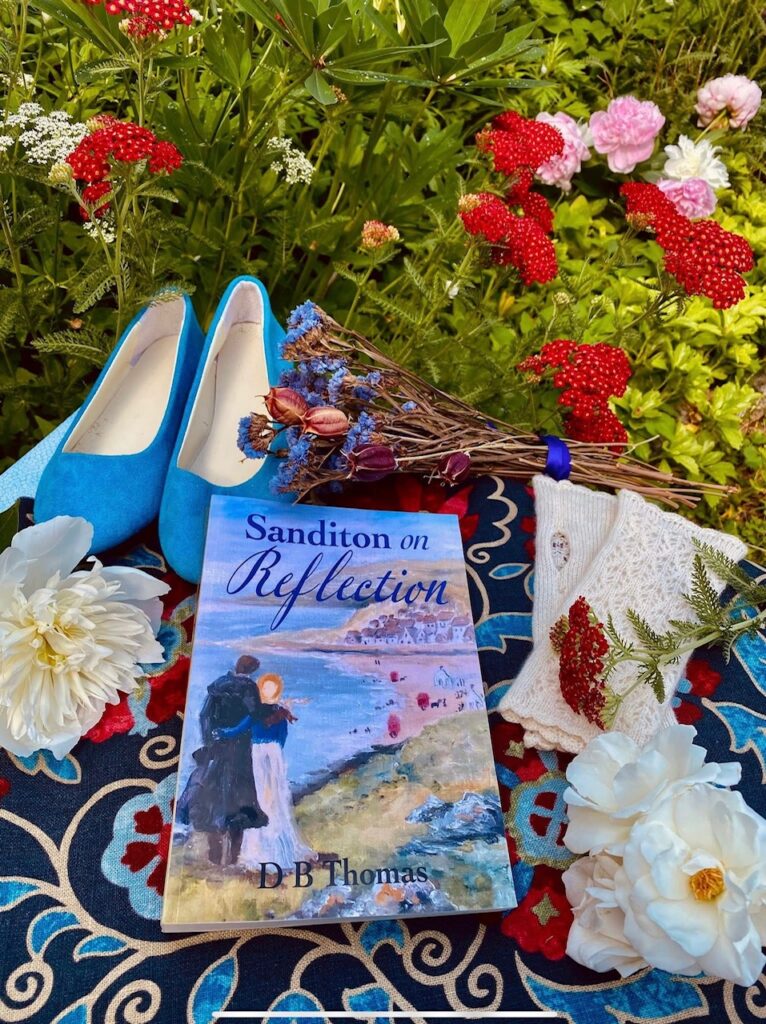
New Review from WaterbearReads - Please go to My Books.
My literary journey continues with the forthcoming release of a British period drama novel, once again drawing from the well of Jane Austen’s timeless appeal. This eagerly anticipated book is currently in the editing stage and is slated for release in late 2024 or early 2025.
Looking Ahead
My literary journey continues with the forthcoming release of a British period drama novel, once again drawing from the well of Jane Austen’s timeless appeal. This eagerly anticipated book is currently in the editing stage and is slated for release in late 2024 or early 2025.
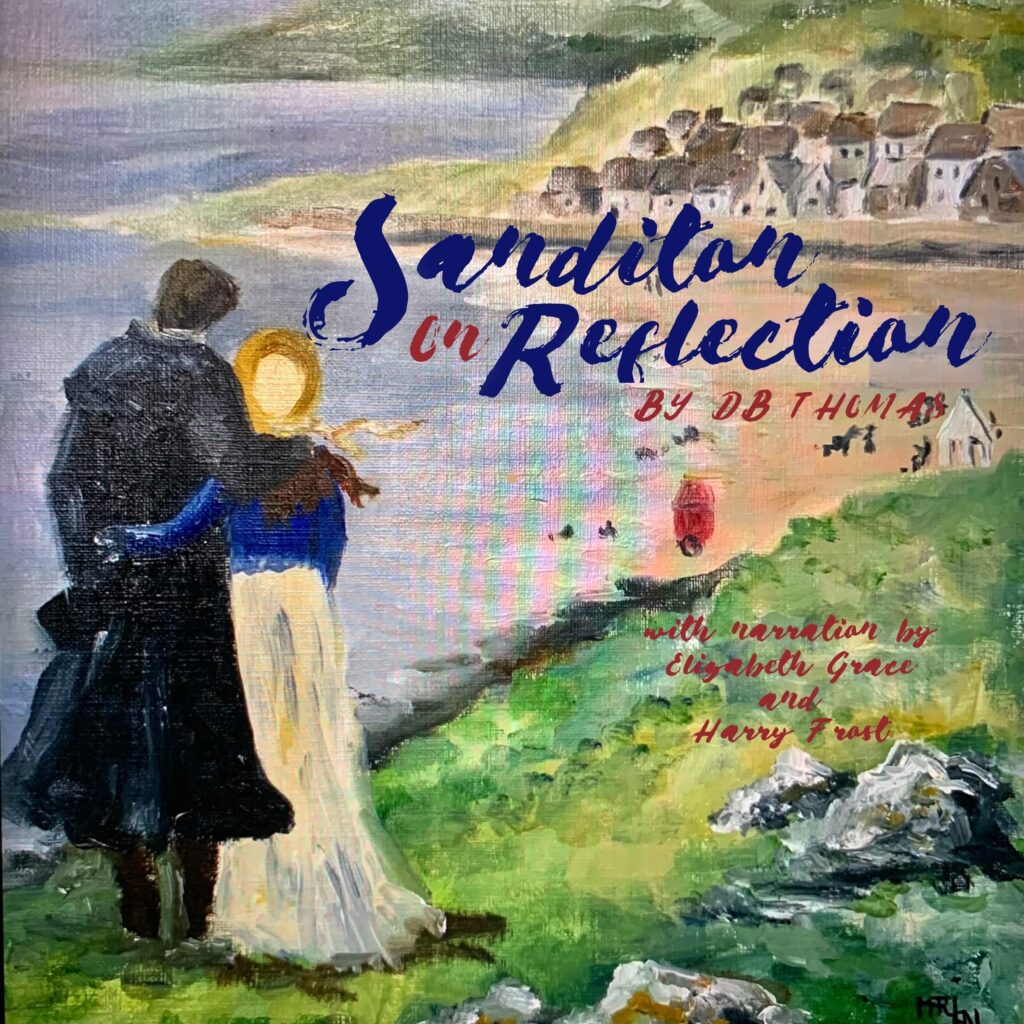
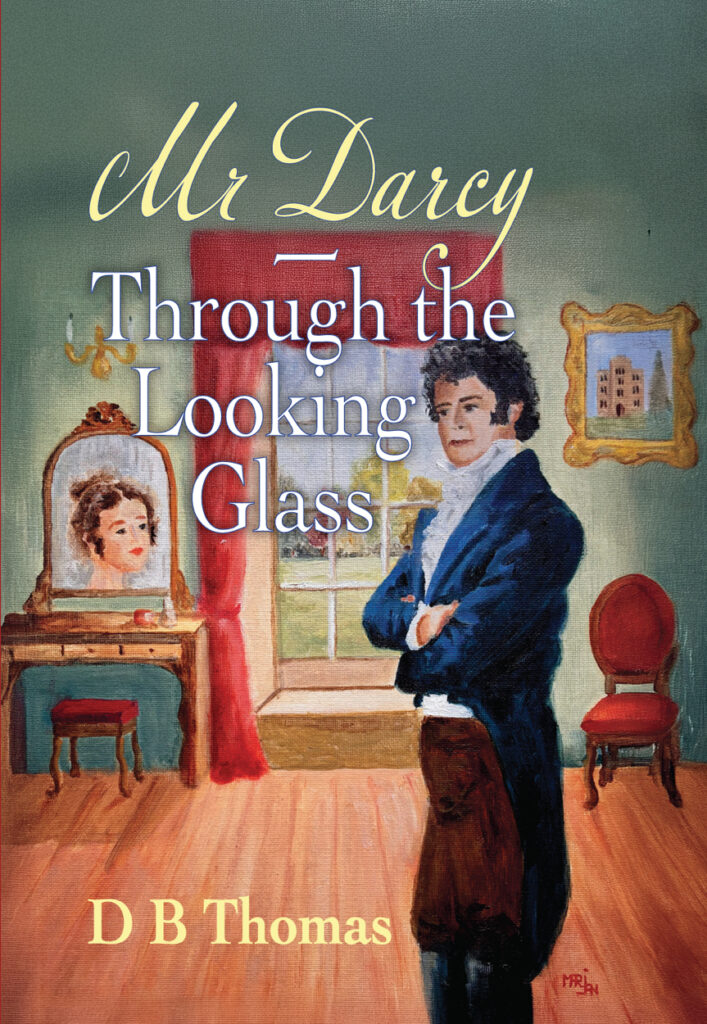
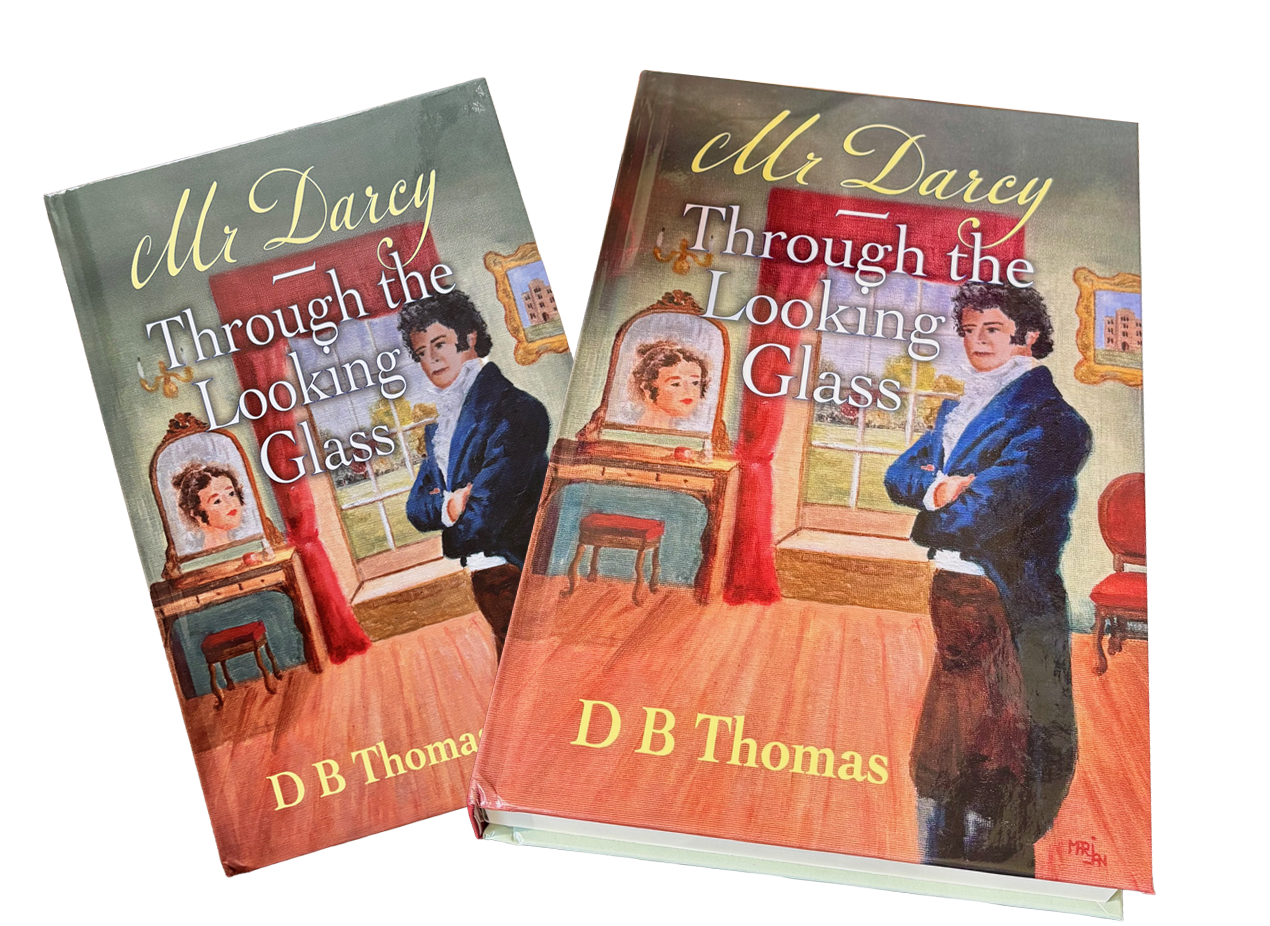
New Book Teaser “Mr Darcy - Through the Looking Glass”
“My newest book, written to honour Miss Jane Austen’s 250th birthday, is now available in hardcover, softcover, and e-book versions. You can find it at Amazon, my book publisher, and many booksellers worldwide. It will release in audio version in May 2026. I believe that every character in “Pride and Prejudice” must have written a diary or journal. After all, it was the way in a time when communication outside the verbal primarily depended on the pen or quill. And in those writings must lie thoughts and even secrets from the minds of Jane Austen’s characters. I celebrate them and Miss Austen in this novel.”
The cover is a painting I commissioned from Marjan de Jonge who is a Dutch Impressionist Painter. Her work has been shown in the world famous Rijksmuseum in the Netherlands. She created the artwork for my books “Sanditon on Reflection/Ricordi di Sanditon” and below is her creation for my new book to be published later in 2024 or early 2025.
Mr Darcy - Through the Looking Glass ©
© 2024 Thomas Hamby writing as D B Thomas. All rights reserved. This book or any portion thereof may not be reproduced or used in any manner whatsoever without the express written permission of the publisher except for the use of brief quotations in a book review.
Foreword
This is the story behind the story of Jane Austen’s “Pride and Prejudice” taken from the diaries as they might have been written by Mr Darcy, Miss Elizabeth Bennet, Miss Georgiana Darcy, Mrs Bennet, Mr George Wickham, Lady Catherine de Bourgh, Mr Collins, Mrs Charlotte (Lucas) Collins, Lady Lucas, Mr Charles Bingley, Miss Caroline Bingley, Mrs Younge, Mrs Reynolds and others. While I claim no special insight into Miss Jane Austen’s mind, I do believe Miss Jane Austen would have been recognized as a psychologist of world renown in a more modern era, especially where matters of the heart are concerned. This book celebrates her understanding, as I see it, of the limits of empathy in human interaction that must be corrected by the heart which always knows what is good and true.
Dedication
I dedicate this book to Miss Jane Austen in celebration of the 250th anniversary of her birth on December 16, 1775, and to her readers and admirers world around.
Acknowledgement and Disclaimer
This novel is a work of fiction and a creation of my own imagination which is based on Jane Austen’s “Pride and Prejudice.” It, in essentials, is a back story from what might have been found in the diaries of characters from “Pride and Prejudice”. I have utilized no sources other than the one mentioned above except for internet research which was undertaken to try to make the story reflect as accurately as possible the era in which it is set. I would also like to acknowledge and thank Marjan de Jonge, the creator of the beautiful cover art.
D B Thomas (Thomas Hamby)
November 2024
Mr Darcy – Through the Looking Glass
Chapter 1
It was a very consequential year for the British Empire in 1807. The slave trade was abolished, Napoleon, the sworn enemy of the Empire, was destroying the allied armies of continental Europe and Russia would declare war. It also was a fateful year for young Fitzwilliam Darcy who was heir to one of the greatest estates in England, for that matter one of the most prosperous in all the empire. He was just a few months past his twentieth year, and he was the only son of Sir Robert Darcy, master of the grand estate known as Pemberley, which was in Derbyshire and in fact was by far the largest estate in the county. But the consequential event that would shape young Darcy’s life and define his happiness came in a very unremarkable fashion as momentous events have a way of doing. And of course, young Darcy did not recognize the event as anything out of the ordinary. It would take him some time, and then an opportunity to look back, remember and then understand the moment for what it was.
Darcy had lived a secluded life until he went to Oxford in 1806, a life that was completely in step with his character. He loved his life at Pemberley. His mother, Lady Anne Darcy, was talented at the pianoforte, she played often and sang in her beautiful voice to his delighted enjoyment. Lady Anne was of noble birth which allowed him access to those who were in the inner chambers of the court and the Ton. He thought little of it. He did not think about it at all. It just was a part of his life, like his rambles in the extensive woods and along the streams around Pemberley. The fact that his birth had given him a special standing in the regency was not appreciated because he did not know it was special. And his father, Sir Robert Darcy, one of the most powerful and wealthy men in the empire was an attentive and caring man to his son, a man who lavished attention on young Darcy ensuring that he wanted for nothing. He had had the services of a tutor from the time he was ten years old and had mastered French and German by the time he was sixteen years of age in addition to being well read in the classics and other volumes of science and accounting from the excellent and extensive library at Pemberley. Young Darcy would be the master of Pemberley one day, and he must be prepared for it. He was alone for the first ten years of his life, an only child. Lady Anne had had much trouble with her first child, had almost died in giving birth to him. But when Darcy was ten, his mother had given birth to another child, had gifted him, he often thought it, with a sister, Georgiana, whom he valued above everyone except for his beloved mother and father. Young Darcy’s world was complete in his mind, and he thought he should have been content never to leave Pemberley.
But, of course, young Darcy’s rank and status as the scion of Pemberley, the lands and the fortune that came with it, came with responsibilities, whether he enjoyed them or not. And as he became a young man, those responsibilities increasingly came with requirements to leave Pemberley, to go to town and other places where there was business to conduct. And sometimes, he must travel with his father to the continent, to address business affairs and learn what he must to manage the estates and fortune that would be his when his father no longer was able. In London, there was his father’s grand town home, Holderness House, which was on Park Lane in Mayfair. As befitting a gentleman of Sir Robert’s wealth and status in the realm, the house was located not far from St James Palace and near to where Green Park and Hyde Park join. It was a comfortable home, and young Darcy could find no fault with it other than it was not Pemberley. Holderness House was the site of most of the entertaining of London society as Pemberley was at an inconvenient distance for many of his father’s and mother’s friends and acquaintances to travel, and it was home when business or requirements of society took the Darcy family to town.
It was there, in town, where young Darcy found his patience early tested by many who sought him out, mostly it seemed, to present themselves to him so he should know them for their future benefit, but most of all, were those who had daughters to be brought to his attention. It was in town where he made his reputation for being reserved, even proud. He was considered standoffish, or at best shy, by many and perhaps he was. But he had learnt quickly that he must resist engaging in anything which might create an obligation on his part or even the impression of an obligation. A dance with a young lady might be considered a sign that he was to become engaged to her. A conversation with a young lady might be viewed as an intimate one. He must not laugh nor appear to be enjoying himself in a young lady’s company. It could bring rumours and gossip which then would subject him to comments and questions and even demands from others not privy to the truth of it. Dance for him was an ordeal, because he could not enjoy it for the grace and beauty that his beloved mother had taught and shown him it was. In the eyes of the beholders, he was in love, or he was to be engaged, and then there could be hurt feelings and tears from young women who had been told or had come to believe, falsely, that he was in love with them. He learnt to be aloof, to affect disinterest, even if he should have preferred to engage for the joy of conversation or the magic of dance. And so it was that he had little affection for balls, nor for making new acquaintances which often came with them for that matter. His status as heir to Pemberley and the great fortune which came with it was well known by one and all. It was a burden that was the envy of everyone except for the one who bore it, young Fitzwilliam Darcy.
So it was that society and engagement with it became an ordeal for young Darcy and by the time he had reached his twentieth year, his preference, if truth be known, was to avoid it and if he could not, to make himself appear proud and unapproachably reserved. The real person whom he was; kind, loving, interested in the world and everything in it, remained behind a facade of indifference and reserve until he was at Pemberley, his sanctuary from the world. There he had his freedom where he could be himself again, where he could lose his defences and be the man that he was. At Pemberley, he needed no one but his mother and father and Georgiana to be perfectly happy and content. And he had thought no further than that until the consequential event which occurred along the road one day in July 1807 between town and Pemberley.
Chapter 2
Young Fitzwilliam Darcy had much to recommend him besides being heir to a vast fortune. He was handsome, well educated, accomplished on horseback and in all gentlemanly pursuits which might be required of him. And one day, he would step into his father’s shoes, take ownership of all the responsibilities that were now his father’s. By 1807, he had been at Sir Robert’s side for three years, since he had attained his seventeenth year, learning what he would need to know and to have mastered when the time came. He would attend Oxford as well and graduate in 1809. It was a requirement of a gentleman that he have an education suitable to his rank and social status and as with all his responsibilities, Darcy devoted his best efforts to excelling at his studies, though he should have preferred to be at Pemberley. But Darcy must know his responsibilities to Pemberley above all. Part of that learning came as he accompanied his father to town where were many of his solicitors, his bankers and his business interests.
On this particular occasion in late July 1807, Darcy had accompanied his father to town to further his education with regard to the requirements of managing and maintaining the Pemberley estate. His mother, Lady Anne, had come with them to consult with her physician. This occasion took them first to London town where Sir Robert Darcy had some business to conduct and to allow Lady Anne Darcy to consult with her physician on Harley Street. Her consultation proved unfruitful as the eminent physician was unable to prescribe a cure for Lady Anne’s discomfort and counseled only that there should be a continuation of leeches, bloodlettings and various draughts to cleanse her body of the imbalance of humours that must be the source of her cancer.
Following the stop in London, the party continued on into Kent and thence to Rosings Park where resided the sister of Lady Anne, the Lady Catherine de Bourgh and her husband, Sir Louis de Bourgh. Darcy had long considered his uncle to be a second father. He did not care for his aunt, however, Lady Catherine de Bourgh. Although she was his mother’s sister, he found Lady Catherine quite unlike her. Lady Catherine was avaricious, treated her servants abominably and was critical of everything and everyone, including her husband, Sir Louis, whom Darcy admired and loved as the fine horseman, mentor and gentleman that he was. Lady Catherine also never failed to mention in her daughter Anne’s and his presence, from the earliest days Darcy could remember, that he and Anne must marry when the time came to bring the great estates of Pemberley and Rosings Park together for the benefit of the family. While Darcy did not dislike his cousin, Anne, he found little in common with her and more importantly to him, found her unread and dull and without any skills at the pianoforte, nor any intention of acquiring them. And her voice found no resonance in his heart nor mind. He always departed Rosings with a sigh of relief though he did leave with regret that his uncle, Sir Louis, must be left in such company.
There was another reason Darcy always enjoyed leaving Rosings Park. The departure marked the day the return to Pemberley would begin. There would be a few stops along the way, to rest the travel party and the horses or change them if required, but going home to Pemberley was always a happy event. And the rest stops were at locations where Sir Robert had standing arrangements and stables with fresh horses if the need to travel at fast pace was required. All their needs would be attended to in the most expeditious and courteous fashion. The normal route from Rosings Park back to Pemberley took them through town with an overnight at Holderness House and then onward in the direction of Oxford and ultimately back to Derbyshire and Pemberley. But the stop which occurred on the occasion of this particular July 1807 return was not one of those locations. Instead, it was just four and twenty or so miles along the road north from town, a location where Sir Robert had never before stopped. But this time he did because of an injury to one of the carriage horses. Sir Robert was particular with his horses and Darcy often thought that his father loved his horses as much and sometimes perhaps more than he did his own family. It was not the truth of course, and Darcy always silently begged his father’s pardon for thinking it.
Chapter 3
Meryton was the name of the town, and the county was Hertfordshire where the stop was made. It was a small place, not much more than a village, thought Darcy, and held not much of interest. There were a blacksmith and stable, a modest inn, a public house, a church, a haberdashery and a few other shops on the high street, which also served as the main road through the town, and not much else at first sight. But first sight does not always tell the tale as Darcy would discover. It was a place that would find a permanent home in his mind if not his heart though first sight of the place did not reveal it to him. And it should be said that it did not because love finds us, not we it. Love is a sly adversary, it must be said, to planning and wit……….
Learn more about my romantic historical fiction works.